
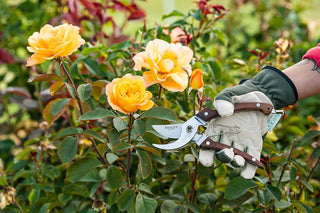
Pruning is one of the most important things you can do for your roses. Done correctly, it keeps plants healthy, improves air circulation, removes dead and diseased wood, and—most importantly—stimulates the vigorous new growth that produces the best blooms. This guide covers everything from basic techniques to specific guidance for each rose type.
We’ll cover:
- Tools & Preparation
- When to Prune Roses
- Basic Rose Pruning Technique
- Pruning by Rose Type
- Deadheading for Continuous Bloom
- Rose Pruning FAQs
For more information about growing roses, see our guide: How to Plant & Care for Roses: A Complete Guide for Every Gardener
Tools & Preparation
Having the right tools makes pruning easier and produces cleaner cuts that heal quickly. Ragged cuts are an invitation for disease and pests.
Essential Tools
- Bypass pruners (hand pruners): for canes up to ½" in diameter. This will be your most used pruning tool. If you are looking to buy good-quality bypass pruners, try Breck's Rosewood Pruners. These are highly rated by our customers!
- Heavy leather gloves: rose thorns are no joke. WellBuilt™ Gauntlet Gloves protect your hands, wrists and forearms from scratches.
- Loppers: for canes ½–1" in diameter.
- Pruning saw: for thick, dead canes that loppers can't handle.
- Exterior carpenter's wood glue, orange shellac or tree seal to protect cut ends from borers.
Preparing Your Tools
- Clean pruner blades with rubbing alcohol or a bleach solution before starting and between plants. If you're cutting out diseased wood, sterilize your blades between each cut so you don't spread disease to healthy canes.
- Sharp blades make clean cuts; dull blades crush and tear cane tissue, creating entry points for disease. Wipe off any sticky sap during pruning sessions.
When to Prune Roses
Main Annual Pruning: Early Spring
In most areas of the country, the primary pruning of the year happens in early spring—typically February or March depending on your climate and zone.
The right moment is when about half the growth buds begin to swell. This signals that the plant is waking up and ready to put energy into new growth.
Don't prune too early. A late frost after pruning can damage tender new growth. Wait for the bud-swell signal during these time frames:
- Zone 4–5 late March to mid-April
- Zone 6–7 late February to mid-March
- Zone 8–10 January to February
Main Annual Pruning Checklist:
- Prune roses to encourage new growth (see Basic Pruning Technique and Pruning by Rose Type below).
- Apply glue or tree seal to all cut cane ends to prevent borers.
- Remove all debris from the rose bed, such as fallen leaves, sticks and weeds that may harbor disease or fungal spores.
- Begin regular watering once pruning is complete.
Deadheading Throughout the Season
Removing spent blooms during the growing season is not pruning in the traditional sense, but it's an essential ongoing task that keeps roses flowering continuously from late spring through fall. See more details under “Deadheading for Continuous Bloom” below.
Fall Pruning: Light Cutting Back
- After the first hard frost, it’s time to prepare plants for winter by doing some pruning. This prevents breakage from winter winds and removes frost-damaged tips—wood you would remove during spring pruning anyway.
- Don't do your main hard pruning in fall. Heavy fall pruning stimulates new growth that will be damaged by frost. Save the main prune for spring.
- See Pruning by Rose Type below for more detailed advice on fall pruning.

Basic Rose Pruning Technique
These universal rules apply to every cut on every rose variety.
How to Make the Cut
1. Identify an outward-facing bud—a small bump on the outer side of the cane pointing away from the center of the plant.
2. Position your pruners about ¼" above the bud.
3. Cut at a 30°–45° angle, with the slope going away from the bud. The cut should be smooth and clean with no tearing or crushing.
Tip: Cutting above an outward-facing bud encourages the plant to grow outward and upward in a vase shape, which improves air circulation through the center of the bush.
What to Remove and in What Order
1. Dead and frost-damaged canes: Cut until you see white, healthy pith all the way through. Brown or discolored pith means to cut lower.
2. Dead canes to the crown: brown, shriveled canes that are dead inside and out; use a saw if necessary.
3. Diseased canes: any cane with blackspot lesions, cankers or other visible disease; cut to the ground.
4. Weak, thin, spindly growth: remove all twiggy interior growth entirely; leave no stubs.
5. Suckers: growth emerging from below the bud union (the graft point). Dig down to find where each sucker connects to the rootstock and remove it entirely. Clipping at soil level just makes them grow back.
6. Crossing canes: Allowing canes to rub against each other damages bark and creates entry points for disease.
7. Remaining healthy canes: cut back by one-third to one-half of previous year's growth.
Sealing Cut Ends
After pruning, seal all cut ends on canes ½" or larger in diameter. Apply exterior carpenter's wood glue, tree seal, or orange shellac to seal the cut ends.
This prevents rose cane borers—insects that tunnel into the soft pith at the center of cut canes and can kill them. This step is often skipped, but makes a real difference in preventing dieback.
The Finished Plant
- Aim for an open, vase-shaped structure with good airflow through the center
- Healthy canes should be evenly spaced around the plant
- No canes should be crossing through the center
Pruning by Rose Type
While the fundamental technique is the same for all roses, each type has specific considerations for how severely to prune, how many canes to retain and when to prune.
Want to learn more about the different types of roses? Read our blog post: Types of Roses: How to Choose The Best Rose for Your Garden
Hybrid Tea Roses
- Prune the hardest of all rose types—cut canes back to 12–18" in most climates.
- Maintain 3–6 strong, healthy canes per plant; remove old nonproducing canes at the bud union.
- Space remaining canes evenly to create an open vase shape.
- Remove all overlapping interior growth to maximize light penetration and airflow.
- In mild climates (zone 7 and up), some gardeners leave canes at 24–30" for a larger, fuller plant the following spring.
- Deadhead throughout the season to keep blooms coming.
💡 Newer hybrid tea plants may not yet be able to support 6 canes—that's fine. Simply prune the strong canes that are present.
Floribunda Roses
- Retain 6–8 canes; most floribundas are low growing and produce a twiggy interior that should be removed.
- Keep the center open with plenty of room for new flower clusters to develop.
- Prune less closely than with hybrid teas—canes can be left somewhat longer.
- These are prolific bloomers; consistent deadheading throughout the season is important.
Grandiflora Roses
- Prune like a hybrid tea, but grandifloras are more vigorous and may support up to eight structural canes.
- These are tall, robust plants that can handle harder pruning and bounce back strongly.
- The long stems make grandifloras excellent cutting roses!
Climbing Roses
- Skip all pruning except dead or diseased wood removal for the first two years—climbing roses need time to establish their mature structural canes.
- After establishment, the goal is to maintain long structural canes and encourage lateral flowering shoots. The best flowering laterals come from 2– to 3–year-old canes.
- Shorten flowering laterals (side shoots) to 3–6" or reduce to 3–4 buds after blooming.
- Remove faded flowers of repeat-flowering varieties to hasten the second bloom.
- For large-flowered climbers: shorten flowering laterals to 3–6″ after each flush of bloom.
- For climbing sports (mutations of bush roses): shorten laterals to 2–6"; remove faded flowers to trigger repeat bloom.
💡 Tie in new canes horizontally or at an angle as they grow. Horizontal training stimulates more lateral flowering shoots and produces more blooms than vertical canes.
Shrub Roses
- Shrub roses require the least pruning of any type, so prune them lightly.
- When the plant is young, prune only to give it shape. When mature, prune to remove twiggy growth and the oldest canes.
- For old garden roses within the shrub category: remove the oldest canes and shorten the remaining ones by about one-third.
- Most shrub roses are self-cleaning and do not require deadheading.
💡 Resist the urge to prune shrub roses as hard as hybrid teas. They have a naturally loose, arching habit and heavy pruning works against their best quality.
Miniature Roses
- Prune essentially the same way as larger roses.
- Remove dead, diseased and crossing canes; maintain an open shape.
- Deadhead regularly for continuous bloom—they are prolific rebloomers.
- For hanging basket miniatures, trim to the edges of the basket and flatten the crown.
Patio Roses
- Prune like a floribunda, but scale down—these are smaller plants.
- Deadhead consistently for best performance in containers.
- In containers, pruning in spring also gives you the opportunity to refresh the potting mix.
Tree Roses
- Cut the head canes back to 8–12" in early spring.
- Always remove any growth from the trunk below the upper bud union—this is critical.
- The pruning principles are the same as for the variety grafted on top, but the plant is at eye level—so an attractive, balanced and symmetrical structure is especially important.
- Check the support stake at each pruning to ensure it is not rubbing or chafing the trunk.
Groundcover Roses
- Require very little pruning—these low-maintenance roses need almost no intervention.
- Remove dead or crossing stems and shear lightly to shape.
- These are bred to be self-maintaining, so overpruning is more likely to be a problem than underpruning.
- Can be sheared or deadheaded lightly after the main flush of bloom if they become untidy.
Deadheading for Continuous Bloom
Deadheading is one of the most effective things you can do to keep your roses blooming all season. When you leave spent flowers on the plant, the rose shifts its energy from producing new blooms to producing seed (rose hips). When you remove spent flowers, that energy goes back into new bloom production.
How to Deadhead
- Wait until petals have fallen or are clearly spent and fading.
- Find the first five-leaflet leaf below the spent bloom (count down from the flower: most leaves close to the top have three leaflets; the first one with five is what you're looking for).
- Cut at an angle just above that five-leaflet leaf, ¼" above an outward-facing bud.
💡 Cutting to a five-leaflet leaf ensures you cut into mature wood that will produce a strong new stem and flower, not just a weak new shoot.
When Not to Deadhead
- Shrub roses: most are self-cleaning—petals drop on their own as they mature, and new blooms follow without deadheading.
- If you want rose hips for winter garden interest or wildlife, stop deadheading in late September to allow hips to develop.
Rose Pruning Guide FAQs
Why do you even need to prune rose bushes?
Pruning roses keeps plants healthy, improves air circulation, removes dead and diseased wood, and—most importantly—stimulates the vigorous new growth that produces the best blooms.
Can I cut back roses in September or in the fall?
Don't do your main hard pruning in fall. Heavy fall pruning stimulates new growth that will be damaged by frost. Save the main prune for spring. It is OK to do light deadheading to remove spent flowers and prevent the forming of rosehips.
How aggressively can you prune roses?
That depends on what kind you are growing. See our guide for details about how to cut back roses by type.
Can I kill my rose bush by pruning it wrong?
It's hard to do permanent damage to a rose by pruning too little. It's equally hard to kill a healthy rose by pruning too much. Heavy pruning typically encourages new growth, although if you prune too much, you may reduce flowering.
How do I know when it's the right time to prune my roses?
The right moment is when approximately half of the growth buds begin to swell. This signals that the plant is waking up and ready to put energy into new growth. Don't prune too early. A late frost after pruning can damage tender new growth. Wait for the bud-swell signal.
What's the difference between pruning for big flowers vs. more flowers?
To produce larger flowers, you must prune aggressively by removing most of the growth to focus the plant's energy into a few select, heavy canes. Conversely, pruning for a higher quantity of flowers requires a lighter touch, leaving more healthy canes intact to provide a greater number of blooming sites across the plant.
A Final Pruning Thought
It's hard to do permanent damage to a rose by pruning too little. It's equally hard to kill a healthy rose by pruning too much. Don't be afraid to prune—roses are resilient and regular pruning is the secret to their best performance.